Showing posts with label good people. Show all posts

Monday, 19 November 2012

Supa Fresh Youth Farm - Tigard, Oregon


On our road trip north from California in the winter I visited Supa Fresh Youth Farm to chat with their program staff. It was the off season so there wasn't much youth action going on but they sure have a mighty inspiring project! 

Located in Tigard, Oregon, the Supa Fresh Youth Farm is entering its third growing season. Originally a work-learning program that connected youth with paid work placements at local businesses, the farm project started when a staff member found a long forgotten garden space tucked in the back corner of the local elementary school. 


The program is funded through the Oregon Human Development Corporation (OHDC) to hire youth participants who are between the ages of 16-21, currently in a school program and who face systemic barriers to accessing employment. Youth participants farm the garden space, growing fresh produce that they sell at the local farmer’s market while working on their employability skills and gaining valuable work experience.


Farm gates.


Youth farmers designed and built the arch.
Participants have their own schedule for farm days, attending the program at a pace that suits them. They keep track of their hours and receive a stipend of $600 for every 100 hours of work they put in. Supa Fresh has an informal partnership with an alternative school that they share office space with. The school is able to refer students that are looking for work, and Supa Fresh is able to connect their youth interns with credit recovery programs offered through the alternative school. Currently, their high school graduation rate is higher than the district average.

Pavilion for learning and farmer lunches.
The program maintains a focus on entrepreneurship and employability skills development. Youth are responsible for growing and preparing the harvest for market, as well as actively selling their produce at the farmer’s market. Each season they design and sell t-shirts as a way of fundraising for their program and raising awareness for their food security initiative. Programming includes cooking classes, team building exercises, a camping trip and opportunities to work alongside local farmers and chefs. 

Check out their website - lots of non-rainy winter photos! 


Hay bale beds - cost effective, warm up quick and
break down into organic matter at the end of the season.

Wednesday, 14 November 2012

Edible Schoolyard - Berkeley California


Working in food literacy education these past couple years I always looked at the Edible Schoolyard and dreamed of seeing their work. This past winter I was lucky enough to take a tour of the Berkeley site. I took one million notes and was fascinated by hoe they make it all work. Here are the details. Totally dreamy! 


How it Started

Alice Waters, of the restaurant Chez Panisse, was quoted in a news article speaking about how to improve food in local schools. She said that local MLK School in her neighbourhood was a perfect example of what not to do – lots of pavement and neglected space. After reading it, school Principal Neil Smith contacted Alice and invited her to come visit MLK and offer her support.

She discovered that Neil had just recently planted a school food garden and was interested in making his school better. As the third principal in 2 years – he knew his school had a poor reputation and he was committed to creating a more positive learning environment.

Alice identified three ket areas for improvement:
Students needed to garden together
Students needed to cook and eat together
- Students needed to eat real food in their cafeteria

Together they decided that they couldn’t do it all at once, but they could start with the garden. Alice found $10,000 to start the project, and Neil had one acre of paved land on the school property that could be converted to garden space.

In 1995 they stared by tearing up the asphalt and planting cover crops. They had one garden teacher for the summer who came in and asked for the school’s 10 toughest students. Together they built raised beds and began gardening on school property. With student engagement they started to get buy-in from other students in the school. The Garden includes a four pile compost systems, a chicken coop, tool shed with mobile tool racks and lots of fruit trees and vegetable garden beds.

In 1997 they started their Kitchen program in an old cafeteria in the school. They soon renovated an old building that was right beside the garden so that the kitchen and cooking programs could take place directly beside the garden – students would harvest their fresh produce and take a few short steps to prepare their harvest.

The Dining Commons is part of the School Lunch Initiative, which is a Public-Private partnership between the Centre for Eco-Literacy, The Chez Panisse Foundation and the Berkeley Unified School District.

Schoolyard Propagation.

How It Works – The Garden:

The one-acre garden serves all students in the school and connects to their science curriculum. The Garden sees each grade for a six week cycle at a time. In each week, every grade 6 science class will visit the garden for one 90 minute session. After a six week cycle (six visits for each class) the Grade 7 students will participate in garden sessions.  After the Grade 8 students cycle through, the Grade 6 students start again.

Each session is 90 minutes long so to provide enough time for students to really get into their garden task and ensure enough time for clean up and wrap up. The Science teacher attends and participates in each session. They do not facilitate the lesson (the Garden Teachers do this,) but they find it is easier to draw connections to what they are working on in the classroom and ensure that the sessions are relevant to their other class work.

Garden Lessons usually have a ratio of 30 students, 1 Garden Teacher, 1 Classroom teacher and a volunteer or intern. Content comes from California Science Curriculum. Some are also connected to Edible Schoolyard Standards.

4 Pile Compost System - Very different regulations for Berkeley schoolyards! 

All sessions start with an opening circle of around 5-15 minutes where that day’s concept is introduced. They then introduce the seasonal garden tasks for that day that need to be done. Garden Teachers are sure that the work they ask students to do is real work that needs to be done – they do not give out “busy work.” Students self-select into work groups that last about 45 minutes. Tasks could include watering, harvesting, mulching, composting or caring for the chickens. Tasks such as mowing are left for adult volunteers. Garden Teachers do have a guiding question – if a task cannot be done by a student, is it necessary to have in the garden? Sessions end with a closing circle where they revisit curricular concepts or questions about work tasks. Closing circle often includes a tasting of a fruit or veg that was harvested that day. Students are encouraged to try and describe their taste with a sensory work rather than an opinion word. (ie. slimy vs. gross)
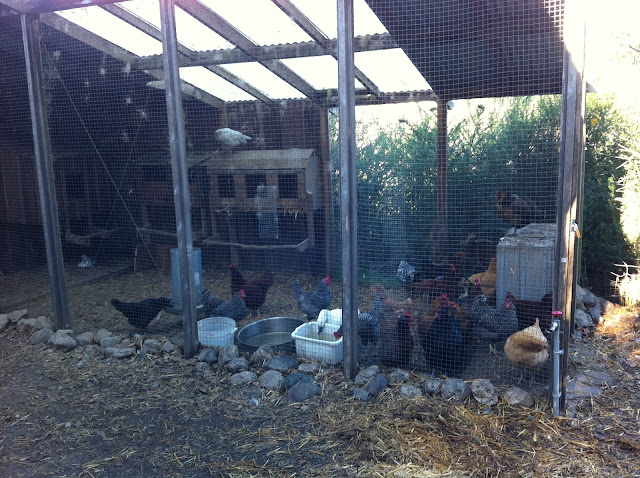
Schoolyard chickens - free range during the day, they get the garden to hang out in.


A well-stocked, warm, delicious smelling kitchen!
How it Works – The Kitchen:

The Kitchen has three large square tables in the space. The walls are covered in posters and pictures of food, plants, recipes and images of healthy cooking. There are shelves of cookbooks for students to use as well as a piano that students can play during dishes. There are a few stoves, sinks and one large commercial dishwasher. Kitchen Kits are made out of wood and include a set of commonly used tools – there is one kit for each table.

At the start of each session, students and teachers gather around the central table for a “Chef’s Meeting.” They introduce both the Humanities curricular concepts as well as the dishes that are going to be prepared that day. When I visited, they were studying African Heritage and cooking a Black Eyed Pea Stew.

The students are split into 3 Families – each at their own table. The Kitchen Teachers, Volunteers and Classroom Teacher are split evenly among the three groups. They each make the same recipe – each table acting as a cooking station.

Students are responsible for preparing all aspects of the dish as well as setting the table with tablecloths, a centrepiece, water glasses and all cutlery. Once the meal is ready and the table is set, they sit down to eat as a family. They try to teach common social conventions of eating – such as waiting until the whole table has been served before trying their food. Everyone gets an equal portion of the dish, and then seconds are given out after everyone eats together.

Conversation cards are used at each table to help to facilitate good communication skills around eating in groups. The questions are meant to be provocative for a middle school student – such as “would you rather work at a job you love that paid little money, or a job you hate that pays lots of money?” The teachers are all apart of the family meal and participate in the conversation lead by the students.

Dishes are done by one family (and they often argue over who gets to do it because they enjoy the big commercial dish washer!) Tables are cleaned up and students not doing dishes are encouraged to read cookbooks, chat with their family or play the piano.

The session closes with a concluding chef’s meeting where as a group they talk about their meal prepared and curricular connections for the lesson.

Each cooking session has to include at least one item from the garden – they try to create dishes that have a majority of either ingredients from the garden or ingredients that could be grown in their garden (ie. would work in the local environment.)

Kitchen Kits - each family of students gets one of these to use.


How It Works – The Dining Commons:

Locally sourced, scratch made hot dishes
+ a salad bar, every day.
The Dining Commons in the school prepares from-scratch lunches for the Berekley Unified School District. They function as a central kitchen for both the MLK student’s lunch, but also other schools in the district. At the school, they feed 500 students.

There is a focus on fresh, local ingredients. If an item is not made in house, they are supplied by a local purveyor. For example, samosas and buns are made by a local baker so that they prioritize supporting the local economy – and so that they can work with that local baker to ensure the ingredients and nutrition content meet government nutrition standards. They provide organic milk from a local farm, all meat is from raw and there is always vegetarian options and vegetarian days.

The cafeteria tries to be as low waste as possible – they use real dishes instead of disposable and all food scraps go to the onsite garden and other local compost programs. Students sort their waste at the end of the meal, and the success of this is in part to their understanding of composting from their time in the garden.

Executive Chef Bonnie Christensen has been very successful in creating dishes that the students actually eat. She does this by involving them throughout the year in the meal planning process. She provides “What’s on Your Plate” tastings for the nutrition classes where students taste the menu items and give their feedback. This could be three varieties of a dish such as coleslaw, or tasting a new menu item such as samosas. Bonnie notes that the students will always eat more of the food offered if they get to see it and taste it before getting to the Dining Room. 

The project took a large investment in the beginning to outfit the building, but now does not rely on donations – it is able to financially break even. Bonnie says she runs it like a restaurant and tries not to rely on subsidies or funding.


The beautiful place where students eat lunch! Lots of funding went into this space.
Resources

The Edible Schoolyard recently re-modeled their website and have created a hub of food literacy resources from across North America. You can access many of their lesson plans and publications, but the part I love the most is teachers, schools and small non-profits from across the country and signing up and sharing their own workshops, lesson plans and activity outlines. They are creating a real centre for folks to access food literacy resources for all grades, connected to every subject and coming from a variety of school gardens. There is some really lovely, innovative stuff on there! 


Sunday, 11 November 2012

Growing Power Visit


On our drive from Vancouver to Toronto we were able to visit Growing Power in Milwaukee. This organization is amazing! We had a really in depth tour from one of the staff who shred lots of the organization's history and current focus. The project started in 1993 when Will Allen bought a 3 acre historic farm - the only remaining agricultural land within city limits. The neigbourhood around the farm was a food desert with few grocery store options in the area and few transportation options to access other options. The farm operated as a roadside grocer for the community - providing fresh healthy produce for those in the neighbourhood. The project became a youth employment program providing training and paid work for youth in the community as well as service learning opportunities for local college students and farming interns.

The work they do is incredible - with a focus on building healthy soils they have a large vermicomposting operation and they are also doing some really innovative aquaponics systems. They now have farms across Milwaukee (with a goal of 20,000 gardens in the city!), neighbouring towns like Oak Creek and a satellite office in Chicago with some great urban farming projects. THe Milwaukee office has some innovaitve corporate partnerships, runs 8 school yard farms and also has a Green Jobs training program that builds hoop houses for sale.

Their goal is to provide equal and even access of good quality food for everyone and really propagate the idea of growing food sustainably. They offer really great workshops, courses, tours and a fall conference - so if you can find your way there, I recommend it! Here are a few highlights from the tour.


Healthy Soils

Growing Power composts over 400,000 lbs of food that is donated each week from corporate partners around the city. They maintain a focus on building healthy soils - we can't have nutritious foods with out nutrient dense soils. We saw a few different methods of composting on site, pictured above is a long line of compost bins where the compost gets turned and moves from each bin as it continues to break down. The pots are all growing greens - they had been recently moved inside. They truly grow wherever they can. Finished compost is fed to worms to create vermicompost. They use this in their own production as well as sell it in their store front.


Worm Tea

The compost is also used to create worm tea as pictured above. The tank is filled with water and a small amount of compost is added alongside some unsulphered molasses. The mixture is aerated and the aeration mixed with the molasses food source helps to multiply the amount of healthy bacteria in the tea. The finished tea is then used as a fertilizer and fro improving the biology of the soil.


Mushroom Production


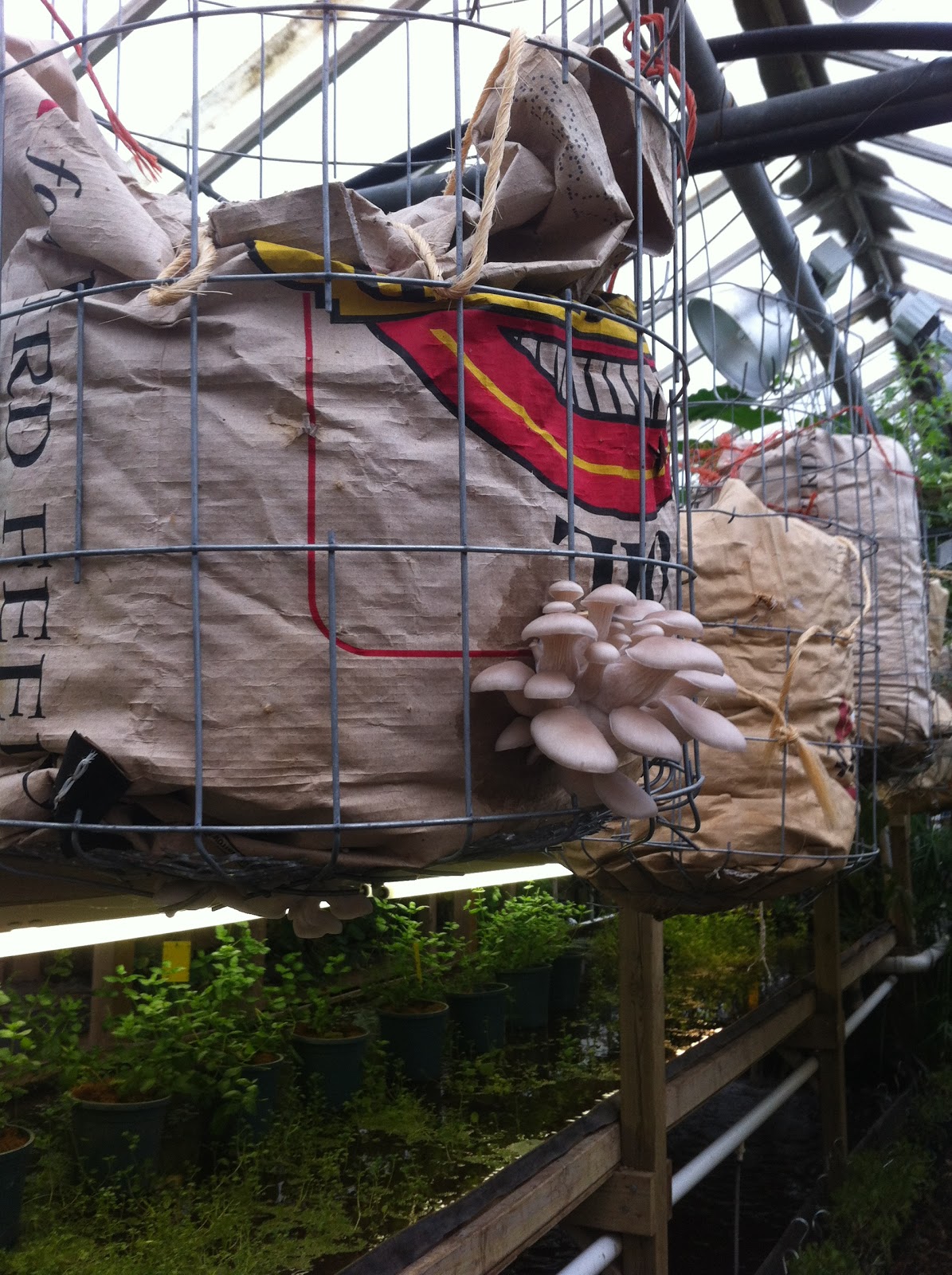
Inside a lot of the hoop houses (there are 10+ at the Milwaukee site!) there are hanging mushroom baskets. They are really making use of all their vertical space. They also grow mushrooms using large boxes made out of old pallets that were smartly tucked away in some unused corners. One exciting thing I saw was hanging shiitake logs above the aquaponic tanks - they work well since the logs really like a moist environment, and the space between the fish tank and the above grow bed goes largely unused.


Aquaponics

Growing Power had lots of aquaponic systems set up, mainly growing tilapia and a few types of perch. The fish waste is converted by bacteria into available nitrogen for the plants and the water is filtered through a grow bed - the plants take up that nitrogen and in exchange are filtering the water for the fish. The system pictured here is absolutely the largest system I have ever seen. This pool has 12,000 gallons of water! There are 4,000 tilapia growing in this system and the grow beds that filter out that water run the whole length of the greenhouse. Lots of nasturtiums, tomatoes, taro and watercress filtering out the good stuff.


Hotmash & Goats

The hoophouses are unheated so to keep them warm over the cold Wisconsin winters the sides of the houses are piled up with a mixture of spent grain mash from local breweries and manure. The farm has several goats that they keep mainly as a source of manure and as an educational component - no milk or meat. They also have a chicken house that provides eggs, but they also value the chicken manure. With these manure sources, they don't have to rely on any purchased sources of fertility which is amazing.


Friday, 14 September 2012

Sole Food Farm

The farm I am apprenticing at here in Vancouver is called Sole Food. Originally a project of the organization United We Can, Sole Food started as a way to provide employment for residents of the downtown eastside - folks that are often working through addictions and mental health challenges. Seann Dory was the Manager of Sustainability at United We Can and he recruited Michael Ableman to help him start this project. The first farm was built on a half acre parking lot beside the Astoria hotel, an SRO (single room occupancy) hotel on East Hastings.
Farm site at the Astoria Hotel


The downtown eastside neighborhood is an interesting place. There are disproportionately high levels of homelessness, material poverty, drug use, Hep C, HIV and diabetes. It is an incredibly food insecure place. Housing is mainly SRO units, transitional housing and BC social housing. Most folks do not have access to a kitchen and there is one grocery store in the entire DTES. If interested, this report from the DTES Kitchen Tables Project has lots of good info on the food security of the DTES.

The neighborhood is also a warm place full of people that care about their community and care about their neighbours. They say hi on the streets and check in with each other. It's been a fulfilling place to farm. I'll share more thoughts about the complexities of this place in another post. 

With only a half acre parking lot to work with, the farm was able to accomplish a lot. They grew year round, crops of delicious veggies - kale, rainbow chard, beans, peas, melons, tomatoes, beets, herbs, strawberries, lettuce, arugula, spinach. They sold at Farmer's Markets and to some restuarants, genereting over $60,000 in sales in year 3. An impressive feat for a small scale urban operation.

The farm has always relied on community grants to operate and to be able to employ folks from the neighborhood. This winter, they dreamed up a plan to expand their acreage to be able to grow enough to become commercially viable. With lots of hard work and serious planning, the farm worked out a model that would see expansion into a network of small farm sites (totalling 4 acres,) that would allow the farm to be completely self financing within four years. This is big, folks. Lots of urban farming projects in North America still rely heavily on grant money or private funders. They are often symbolic demonstration sites or teaching gardens (and these are good!) But this here is a real honest-to-goodness farm with high production levels.


This season we have worked so hard - dragging 3,000 pallets across a 2 acre site to set up growing boxes, building 4 greenhouses in a month of pouring rain, setting up 1.5 acres of farm on contaminated brownfields, growing massive amounts of produce that had to be cooled in fridge space located on the second floor of an historic building with a broken elevator. But! It has been so wonderful and I have learned massive amounts. More stories to follow.

Pallets being laid out - soon to become growing boxes.