Showing posts with label school food. Show all posts

Tuesday, 28 January 2014

Market Produce -- Glamour Shots

Beet Bouquets - Merlin, Chioggia & Touchstone varieties

Carrot Bunches - Nelson, White Satin & Purple Haze varieties

Bright Lights Chard & French Breakfast Radishes

French Filet Beans -- Red Rocket, Islander & Tiburon Peppers -- unlabeled eggplant
from the World Crops Project

Costata Romanesco & a last minute addition
yellow zucchini variety that I didn't write down (it happens).

Thursday, 23 January 2014

to the bone

This short film by Erin Li makes a great classroom resource for learning about migrant labour and food justice with young people. 

Thursday, 26 December 2013

We've Been Busy - An Update on our School Farm

Sungold and washington tomatoes.

December has been nice.

I have spent the past month catching up from the growing season - catching up on sleep, catching up with friends, spending more time cooking and relaxing, more time with family.   

The break also means looking back on what we've accomplished this season. 

Some highlights: 

- Our 6,000 square foot garden grossed $14,500 in sales this season (up from last year's $1,300). A substantial jump that I am super proud of. 

- We grew 2,800 lbs of food which is deceptive since most of it was cut greens (hence the higher sales).

- We donated $1,600 worth of fresh produce to student volunteers, school cafeteria kitchens and drop in meal programs. 


- My most favourite: we hired ten high school students who worked full time summer jobs farming and they were absolutely incredible. In July we had a massive heat wave and so started our days at 7 am. I'd roll up to the school at 6:30 in the morning to find a group of high school students ready to work. They did not miss a single day. They were committed to each other and to the project. They would talk to market shoppers about the flavour of patty pan squash and offer samples of sweet sungolds. They held each other accountable in community meetings and they shared what was going on in their lives. They supported each other and made each other laugh - making repetitive farm tasks fun to do. We sat down to weekly meals prepped from scratch in their cooking classes. They were absolutely remarkable. 

- Our students also helped to establish a school rooftop garden at one of the high schools we work at this year. This incredible project was mainly accomplished by the other staff on my team - from designing the space, securing funding, building all the pieces and bringing it all together on site. I was in a real put-your-head-down-focus-on-production zone so wasn't much help with the installations. It's a 16,000 square foot space which now includes raised planters for vegetable production, a small fruiting orchard, 92 blueberry plants, shittake mushroom logs, a covered learning area and a classroom right off of the space. The students were a huge support in getting this project done this summer and I'm looking forward to growing lots more food next season as our production space increases.

Our story's been shared a few times too. You can read more here: 


Friday, 21 June 2013

A week in schoolyard farming.


I’ve been working towards a master’s degree at OISE, studying food literacy and schoolyard farming over the past year. For a food justice course, we were asked to volunteer in a community food organization and document our work on a blog. I was able to keep up the work I have been doing and share some of that experience here in this blog.

Writing about my current job as a schoolyard farmer has been on my mind all week, and so I decided to give you a (brief) snap shot of what a week looks like for this schoolyard farmer.


Market Banner.
Monday: office work - we need help.

I have been running a quarter acre market garden built on the front and back lawn of a Scarborough high school. The garden has been at the school for 3 years, this being our fourth season. Each year we get funding to offer paid employment to five students – they get full time summer jobs growing food at their school. Each year we also have to raise enough money in grant writing or fundraising to cover the cost of a staff member to run the garden and supervise the youth. My work this year has been to try and shift this towards a production focused farm – we are going to try and gross enough in sales of fresh produce to cover the operating costs of the project. If we can do that – we have a replicable, financially sustainable, model of schoolyard growing for other sites/communities. I’ve developed a business plan and crop plan that saw us out in the field in early April seeding peas and onions – this meant we had crops in the ground a full two months prior than any other season. We are focusing on growing high-value crops – cut lettuces, baby spinach, spicy greens & arugula. These sell well both at markets and restaurants – and that is our plan. In previous years the students set up a farm stand in the front of the school to sell their produce. We’ll keep that up, especially in the fall when the Business class is going to run a market stand and the harvest is bountiful. But we are also selling to local restaurants (those that prioritize local food and will pay $12/lb for cut greens). We are also selling at a farmers market throughout the season.

This plan means an increase in revenue, but it also means in increase in workload, an increase in the amount of time we need to spend in the field, the amount of time we spend processing and cooling produce, and the amount of time we spend delivering and marketing our goods. We need help. On Monday I sifted through a few resumes of folks applying to apprentice with our project. As someone who apprenticed at an urban farm in Vancouver, it’s nice to see people in cities searching for farming opportunities close to them. There has been a much talked about spike in the numbers of young city dwellers that are interested in trying farming. And with our average age of farmers in Canada at 54 - it’s a good time to get young people out into the field.

Its hard to market the realities of farming – there is a romantic notion of working in the sun, birds chirping, your muscles toned, the fruit sun-ripened and waiting to slip into your hand. In reality, you often do the same task for hours. You work the same muscles over and over. You pull weeds to return to more weeds. You plant starts to return to eaten starts. It doesn’t rain. It rains too much. You are exhausted and there is still more to do. And you have to do it. It cannot wait. How do you put that in a job description? How do you find the people that are willing to give the reality a try?


Me and OISE interns Sarah and Katey. 
Tuesday: “It wasn’t alfalfa, it was a truck full of juice” (& “a woman manager?!”)

Urban farming has its benefits – I am close to my markets, have quick and easy access to irrigation, I get to live in the city, folks can buy food from me that was grown next door to their house, we are making use of vacant land, providing paid employment for youth (etc.) Making cities more liveable. But there are struggles too that are unique to the setting – especially a schoolyard farm. To name two: I can’t store a composting manure pile out back & there aren’t many (any) farm supply stores in town. So I needed a to find a way to add nutrient rich organic matter to our soils (ie. not a manure pile) and I needed to find it in the city (ie. not likely). I finally landed on this brewing alfalfa method as a way of adding nitrogen, good bacteria and moisture holding organic matter to our garden beds, but I needed to source thirteen 50lb bags of pure alfalfa pellets. Phoning every farm supply in southern Ontario, folks were often not able to hold back their disbelief when they asked where I was calling from - a farm in the city? at a school? and you want us to deliver there?

After a long search I finally found a supplier that was nice enough to order in what I needed and deliver it to the school. I was working out front with some students, chatting with them about what we were going to do with the alfalfa when it came. A van pulled in and they said, “Maybe that’s your guy.” I walked up and shook his hand, he asked me about the garden beds out front, told me about his own garden. He then opened up the van and turned out to be the juice delivery guy, here to restock the vending machines. The students ate that story right up. I heard juice jokes for the rest of the week.

Later the folks from the farm supply did arrive (and their truck was in fact full of alfalfa pellets, not juice.) Instead of approaching me out in the beds, the driver chose to head in to the office to find the person in charge. This has happened before – the person in charge here is usually assumed to present as male. I do not often fit their assumption of what a farm manager should “look like.” A few months ago a neighbour came by to ask about some seeds. We had a classic “Who’s on first” moment: Who’s in charge? I am. No, who’s in charge? I am. No who is the manager? Me.

"A woman?!"

He finally smiled wide and showed me his seeds and we talked about pepper seedlings and winter squash. Women do not fit our stereotypical image of a farmer. And yet many of the hardest working farmers I know are women – and many of the innovative urban farmers in Toronto are women. I often feel conflicted about this. I have read so many times that women make good farmers because they are nurturers, care givers, because they are naturals at multitasking. I think this is just perpetuating patriarchal gender norms. I think farmers are nurturers – we are called to a life dedicated to caring for other life. If anything I think that I like being a female farmer because it is a subversion, it is a rupture in the norm of what I, a woman, am expected to do. Farming is a feminist act, for me.


Spicy Greens Mix
Wednesday: “I have something to tell you.”

At lunch in the staff room eating soup prepared by students in the foods class. Seated at a table of teachers, we’ve talked about whether there is still time to seed carrots and what people have planned for their upcoming summer break from teaching. One teacher put down her fork, looked me in the eye and said “Katie, I have something to tell you. And it may be hard to hear.” I truly prepared for the worst. Racking my brain for something disrespectful I’ve done, a misstep I’ve made. She shared that she came to our farmers market the week before and bought a bag of mixed lettuce. She then went to another market on the weekend and discovered that farmers there were selling bigger bags of greens for less money.  I exhaled in relief – folks sharing complaints about the cost of produce is nothing new to me. I thanked her for sharing this and really tried to make sure she felt comfortable to continue to do so in the future.

We sell our greens at $5 for a 1/3 lb bag. If someone else sells theirs for $4 for a 1/2 lb bag – that’s only $8 per lb. That is most likely not even covering their cost of production, much less making them any profit.

When I developed my crop plan for this season I had it reviewed by a few veteran organic farmers. Worried that our prices were too high, they all came back to me saying our prices were in fact too low. They did not want our reduced operating costs (ie. free land, student farmers) to be undercutting their prices. And even with our reduced operating costs, at $8/lb I wouldn’t cover my cost of production either.

We talked about how farmers aren’t taking home a lot of money and consumers are pushed to pay more – where is the money going then? We talked about agribusiness and monocropping and cash crops and GMOs and food subsidies and organic certification and why the heck is a candy bar so cheap and lettuce so expensive? Our table in the staff room was a light with engaging conversation about the food system. I was so thankful she brought this up. And I probably won't change the prices.


Flowers on our Snap Peas
Thursday: “I tell them that they’re beautiful.” (& “Can I have one for my girl friend?”)

Thursday was the last day of classes before exams and then summer break (when our paid summer students will start). To celebrate, we made green spinach smoothies with a blender powered by an old road bike. We said cheers to a semester of hard work in the garden and sipped our smoothies. We also set up the big screen and watched a clip from cbc news about our school farm. When the news team was here, they filmed the students prepping beds and feeding the aquaponics system. They also interviewed a few students, just out of earshot, so their comments were a surprise to myself and the teacher I work with. The clip they chose reflected the positive change seen in these students now that they work in the garden. One student shared that he talks to the plants when he is out working in the garden, “I tell them that they are beautiful.” The students loved it. I loved it.

As a final project we built tomato trellises. One student who isn’t always in class, as he has a full time night shift job, came that day – we made him crew lead for the build and he taught his follow students how to read the design dimensions and how to use the impact driver.

After class he saw me harvesting peas for the market that afternoon. He came over and said “I remember planting these.” I gave him one to eat, “they are snap peas, you can just pop them in your mouth.” He said, “I’d actually like to keep this one for my girlfriend, I really want to show her.” I gave him five more. He tried one and we sat there for a few moments eating sweet snap peas in the sun. He said he was happy he came to school that day.


French Breakfast Radish

Friday: “My boyfriend broke up with me and also what’s with this radish?”

The first day of exams I didn’t have any students come out to work as they were all taking tests. I got to work with the help of a volunteer harvesting 10 lbs of spicy greens for a restaurant order. We used our harvest knives to cut the greens and trim the stems before taking them in to wash and cool. One student came out, proud of completing her math exam. She asked if she could stick around, would that be ok. I said of course and got her working beside us in a radish bed. While she was pulling and sorting radishes, she shared that her boyfriend broke up with her. She would alternate between talking about radishes and talking about her feelings. This happens a lot. Students will come work beside me – harvesting, weeding, or just watching – and they will talk about some deep stuff. Racism, violence, college, relationships, smoking, marriage, why mustard greens are bitter, why their friends moved away, why is that cop always around the school. Farming has just the right amount of getting your hands busy, falling into a rhythm, so that your mind can sort of wander. When you get good at it, you can do the thing you are doing quite well, but also still have some moments of profound thought or conversation while your hands are working. I’ve learned that this farm is important to the students; even those that don’t come out as part of their course work or apply for the summer job. Students notice when we are planting, they pay attention to the growing, they watch the radishes pop out of the soil, they notice the flower that comes before the pea. It means a lot to them. 
And I hope they always have it. 


Sugar Ann Snap Pea


Wednesday, 3 April 2013

start of the season


I've spent the past few months developing a production plan for a school yard farm I'll be managing this summer. We are farming in two school yards (one is a rooftop space) and have funding to employ ten high school students who will also get 2 co-op credits for their work (such a dream situation!) We'll be selling at a farmers market and to a few local restaurants. We've had such good feedback from chefs and farmers - lots of local community support. It was my first time developing a crop plan, and with our focus on tight spaces and lots of quick successions it took a whole lot of time and attention to detail. I'm real happy that I did it though, I now have a fully developed business plan and crop plan that can be easily shared with the teachers and students we are working with and it will make planning in future seasons a breeze!

We've got our seeds, some new tools, row cover, irrigation lines, spring weather, energized students - all we need to do now is start growing. 

Tuesday, 15 January 2013

Lemon Cucumbers


We grew some lemon cucumbers in our high tunnels at both Hastings and Vernon. These babies are delicious! One of my favourite things we grew. They have a similar crunch to a green cuke and the seeds are very similar. I think they taste citrusy, but that may also be because I am thinking "lemon" when I eat it.

Lemon cucumbers are also great for a school garden - any time you can grow something that produces lots of small plentiful fruits is great for students. Just like tomatoes, it's easier to share lots of cherries with students than to try to slice up a beefsteak.

They were also a pleasant surprise for most market shoppers. We would always put out a small chalkboard with the lemon cuke name and do samples of slices. People were always interested to give it a taste and they were always hot sellers.

I've heard that the specks on them are both normal and bad - they brush off with your hand or a soft cloth, but they also are fine to eat. Any insight on what they are?


Monday, 19 November 2012

Supa Fresh Youth Farm - Tigard, Oregon


On our road trip north from California in the winter I visited Supa Fresh Youth Farm to chat with their program staff. It was the off season so there wasn't much youth action going on but they sure have a mighty inspiring project! 

Located in Tigard, Oregon, the Supa Fresh Youth Farm is entering its third growing season. Originally a work-learning program that connected youth with paid work placements at local businesses, the farm project started when a staff member found a long forgotten garden space tucked in the back corner of the local elementary school. 


The program is funded through the Oregon Human Development Corporation (OHDC) to hire youth participants who are between the ages of 16-21, currently in a school program and who face systemic barriers to accessing employment. Youth participants farm the garden space, growing fresh produce that they sell at the local farmer’s market while working on their employability skills and gaining valuable work experience.


Farm gates.


Youth farmers designed and built the arch.
Participants have their own schedule for farm days, attending the program at a pace that suits them. They keep track of their hours and receive a stipend of $600 for every 100 hours of work they put in. Supa Fresh has an informal partnership with an alternative school that they share office space with. The school is able to refer students that are looking for work, and Supa Fresh is able to connect their youth interns with credit recovery programs offered through the alternative school. Currently, their high school graduation rate is higher than the district average.

Pavilion for learning and farmer lunches.
The program maintains a focus on entrepreneurship and employability skills development. Youth are responsible for growing and preparing the harvest for market, as well as actively selling their produce at the farmer’s market. Each season they design and sell t-shirts as a way of fundraising for their program and raising awareness for their food security initiative. Programming includes cooking classes, team building exercises, a camping trip and opportunities to work alongside local farmers and chefs. 

Check out their website - lots of non-rainy winter photos! 


Hay bale beds - cost effective, warm up quick and
break down into organic matter at the end of the season.

Wednesday, 14 November 2012

Edible Schoolyard - Berkeley California


Working in food literacy education these past couple years I always looked at the Edible Schoolyard and dreamed of seeing their work. This past winter I was lucky enough to take a tour of the Berkeley site. I took one million notes and was fascinated by hoe they make it all work. Here are the details. Totally dreamy! 


How it Started

Alice Waters, of the restaurant Chez Panisse, was quoted in a news article speaking about how to improve food in local schools. She said that local MLK School in her neighbourhood was a perfect example of what not to do – lots of pavement and neglected space. After reading it, school Principal Neil Smith contacted Alice and invited her to come visit MLK and offer her support.

She discovered that Neil had just recently planted a school food garden and was interested in making his school better. As the third principal in 2 years – he knew his school had a poor reputation and he was committed to creating a more positive learning environment.

Alice identified three ket areas for improvement:
Students needed to garden together
Students needed to cook and eat together
- Students needed to eat real food in their cafeteria

Together they decided that they couldn’t do it all at once, but they could start with the garden. Alice found $10,000 to start the project, and Neil had one acre of paved land on the school property that could be converted to garden space.

In 1995 they stared by tearing up the asphalt and planting cover crops. They had one garden teacher for the summer who came in and asked for the school’s 10 toughest students. Together they built raised beds and began gardening on school property. With student engagement they started to get buy-in from other students in the school. The Garden includes a four pile compost systems, a chicken coop, tool shed with mobile tool racks and lots of fruit trees and vegetable garden beds.

In 1997 they started their Kitchen program in an old cafeteria in the school. They soon renovated an old building that was right beside the garden so that the kitchen and cooking programs could take place directly beside the garden – students would harvest their fresh produce and take a few short steps to prepare their harvest.

The Dining Commons is part of the School Lunch Initiative, which is a Public-Private partnership between the Centre for Eco-Literacy, The Chez Panisse Foundation and the Berkeley Unified School District.

Schoolyard Propagation.

How It Works – The Garden:

The one-acre garden serves all students in the school and connects to their science curriculum. The Garden sees each grade for a six week cycle at a time. In each week, every grade 6 science class will visit the garden for one 90 minute session. After a six week cycle (six visits for each class) the Grade 7 students will participate in garden sessions.  After the Grade 8 students cycle through, the Grade 6 students start again.

Each session is 90 minutes long so to provide enough time for students to really get into their garden task and ensure enough time for clean up and wrap up. The Science teacher attends and participates in each session. They do not facilitate the lesson (the Garden Teachers do this,) but they find it is easier to draw connections to what they are working on in the classroom and ensure that the sessions are relevant to their other class work.

Garden Lessons usually have a ratio of 30 students, 1 Garden Teacher, 1 Classroom teacher and a volunteer or intern. Content comes from California Science Curriculum. Some are also connected to Edible Schoolyard Standards.

4 Pile Compost System - Very different regulations for Berkeley schoolyards! 

All sessions start with an opening circle of around 5-15 minutes where that day’s concept is introduced. They then introduce the seasonal garden tasks for that day that need to be done. Garden Teachers are sure that the work they ask students to do is real work that needs to be done – they do not give out “busy work.” Students self-select into work groups that last about 45 minutes. Tasks could include watering, harvesting, mulching, composting or caring for the chickens. Tasks such as mowing are left for adult volunteers. Garden Teachers do have a guiding question – if a task cannot be done by a student, is it necessary to have in the garden? Sessions end with a closing circle where they revisit curricular concepts or questions about work tasks. Closing circle often includes a tasting of a fruit or veg that was harvested that day. Students are encouraged to try and describe their taste with a sensory work rather than an opinion word. (ie. slimy vs. gross)
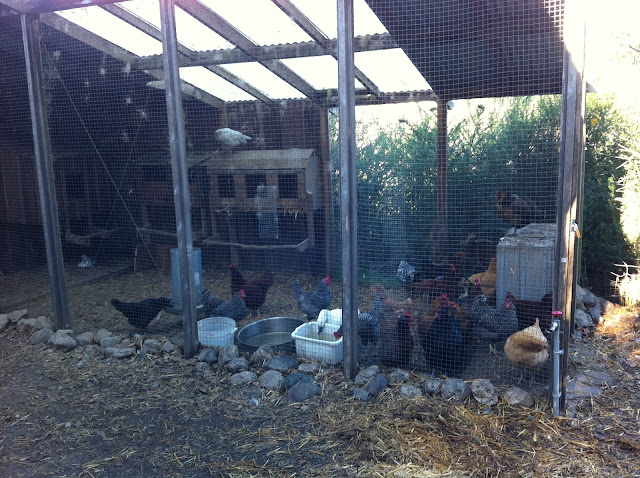
Schoolyard chickens - free range during the day, they get the garden to hang out in.


A well-stocked, warm, delicious smelling kitchen!
How it Works – The Kitchen:

The Kitchen has three large square tables in the space. The walls are covered in posters and pictures of food, plants, recipes and images of healthy cooking. There are shelves of cookbooks for students to use as well as a piano that students can play during dishes. There are a few stoves, sinks and one large commercial dishwasher. Kitchen Kits are made out of wood and include a set of commonly used tools – there is one kit for each table.

At the start of each session, students and teachers gather around the central table for a “Chef’s Meeting.” They introduce both the Humanities curricular concepts as well as the dishes that are going to be prepared that day. When I visited, they were studying African Heritage and cooking a Black Eyed Pea Stew.

The students are split into 3 Families – each at their own table. The Kitchen Teachers, Volunteers and Classroom Teacher are split evenly among the three groups. They each make the same recipe – each table acting as a cooking station.

Students are responsible for preparing all aspects of the dish as well as setting the table with tablecloths, a centrepiece, water glasses and all cutlery. Once the meal is ready and the table is set, they sit down to eat as a family. They try to teach common social conventions of eating – such as waiting until the whole table has been served before trying their food. Everyone gets an equal portion of the dish, and then seconds are given out after everyone eats together.

Conversation cards are used at each table to help to facilitate good communication skills around eating in groups. The questions are meant to be provocative for a middle school student – such as “would you rather work at a job you love that paid little money, or a job you hate that pays lots of money?” The teachers are all apart of the family meal and participate in the conversation lead by the students.

Dishes are done by one family (and they often argue over who gets to do it because they enjoy the big commercial dish washer!) Tables are cleaned up and students not doing dishes are encouraged to read cookbooks, chat with their family or play the piano.

The session closes with a concluding chef’s meeting where as a group they talk about their meal prepared and curricular connections for the lesson.

Each cooking session has to include at least one item from the garden – they try to create dishes that have a majority of either ingredients from the garden or ingredients that could be grown in their garden (ie. would work in the local environment.)

Kitchen Kits - each family of students gets one of these to use.


How It Works – The Dining Commons:

Locally sourced, scratch made hot dishes
+ a salad bar, every day.
The Dining Commons in the school prepares from-scratch lunches for the Berekley Unified School District. They function as a central kitchen for both the MLK student’s lunch, but also other schools in the district. At the school, they feed 500 students.

There is a focus on fresh, local ingredients. If an item is not made in house, they are supplied by a local purveyor. For example, samosas and buns are made by a local baker so that they prioritize supporting the local economy – and so that they can work with that local baker to ensure the ingredients and nutrition content meet government nutrition standards. They provide organic milk from a local farm, all meat is from raw and there is always vegetarian options and vegetarian days.

The cafeteria tries to be as low waste as possible – they use real dishes instead of disposable and all food scraps go to the onsite garden and other local compost programs. Students sort their waste at the end of the meal, and the success of this is in part to their understanding of composting from their time in the garden.

Executive Chef Bonnie Christensen has been very successful in creating dishes that the students actually eat. She does this by involving them throughout the year in the meal planning process. She provides “What’s on Your Plate” tastings for the nutrition classes where students taste the menu items and give their feedback. This could be three varieties of a dish such as coleslaw, or tasting a new menu item such as samosas. Bonnie notes that the students will always eat more of the food offered if they get to see it and taste it before getting to the Dining Room. 

The project took a large investment in the beginning to outfit the building, but now does not rely on donations – it is able to financially break even. Bonnie says she runs it like a restaurant and tries not to rely on subsidies or funding.


The beautiful place where students eat lunch! Lots of funding went into this space.
Resources

The Edible Schoolyard recently re-modeled their website and have created a hub of food literacy resources from across North America. You can access many of their lesson plans and publications, but the part I love the most is teachers, schools and small non-profits from across the country and signing up and sharing their own workshops, lesson plans and activity outlines. They are creating a real centre for folks to access food literacy resources for all grades, connected to every subject and coming from a variety of school gardens. There is some really lovely, innovative stuff on there!